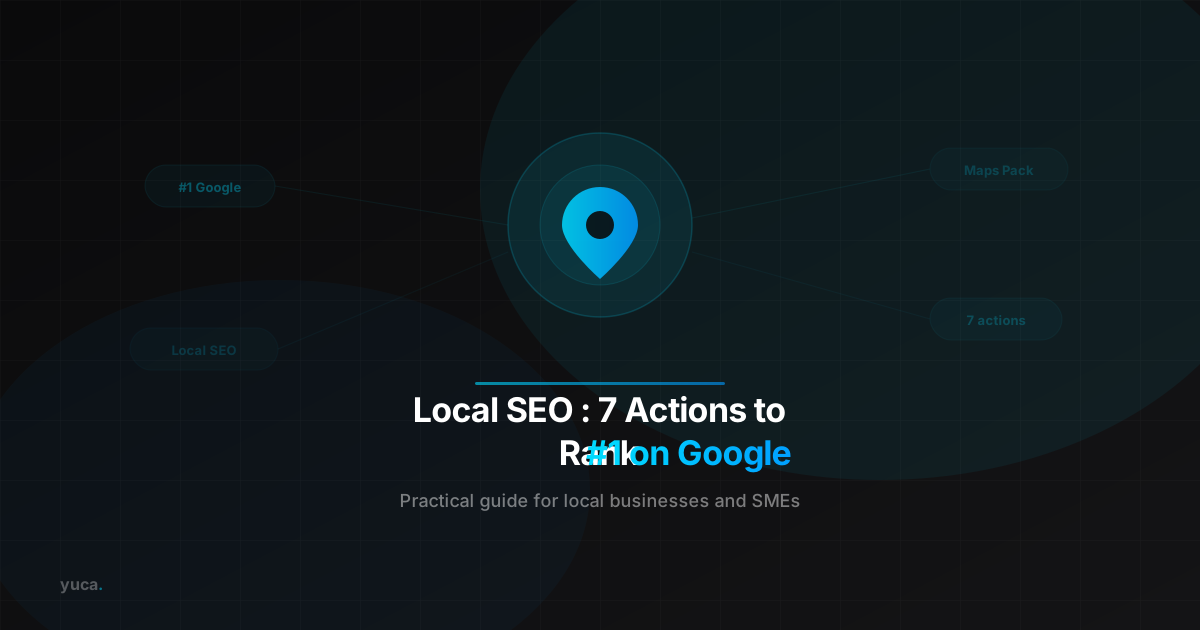
Local SEO: 7 Actions to Rank #1 on Google
46% of all Google searches carry local intent — yet most independent businesses have never optimised their local presence. That gap is your opportunity. Whether you run a restaurant, a boutique, a law firm, or a trades business, the same 7 actions consistently move SMEs from invisible to first on Google. Here is how Yuca implements them.
Why local SEO is the highest-ROI digital investment for SMEs
Users who search with local intent are ready to act. According to Google, 76% of people who search for something nearby on their smartphone visit a related business within 24 hours — and 28% of those searches result in a purchase. Unlike paid ads, which stop the moment your budget runs out, local SEO builds compounding authority that works for you around the clock.
The Google Map Pack — those 3 businesses displayed with a map at the top of local search results — captures the lion's share of clicks. Getting into that box is the goal, and these 7 actions get you there.
Action 1: Master your Google Business Profile
Your Google Business Profile (GBP) is the single most important local SEO asset you own. It determines whether you appear in the Map Pack at all. An abandoned or incomplete profile actively hurts you — Google deprioritises businesses that look unreliable.
- Claim ownership of your listing if you have not already (many businesses have auto-generated profiles).
- Complete every field: exact business name, precise address, phone number, website URL, and up-to-date opening hours including holidays.
- Select the right primary category — this is the most impactful single field in your GBP — and add up to 9 relevant secondary categories.
- Write a 750-character description that naturally includes your main local keywords.
- Upload fresh photos monthly: profiles with recent photos receive 42% more direction requests, per Google's own data.
- Post weekly updates to signal that your business is active.
Action 2: Research and target the right local keywords
Local SEO runs on specific combinations: your service + your city or neighbourhood. Do not guess — validate search volume using free tools like Google Keyword Planner or the free tier of Ubersuggest.
Build your local keyword map by combining:
- Your main service categories with nearby areas and neighbourhood names.
- Intent modifiers: "open Sunday", "emergency", "same-day delivery", "free quote".
- Long-tail queries: lower competition, higher conversion intent.
Integrate these keywords naturally into your page titles, H1 headings, meta descriptions, body copy, and image alt tags. To understand which optimisation mistakes lose the most local traffic, read our guide on local visibility errors.
Action 3: Build dedicated local landing pages
If you serve multiple towns or districts, create a unique landing page for each. Google rewards geographic specificity, and a dedicated page gives you a much better chance of ranking for location-specific queries.
Each local page needs:
- The target city or district in the H1 tag and meta title.
- Original body copy describing your services in that specific area (never duplicate content between pages).
- Local customer testimonials mentioning the area.
- An embedded Google Map showing your location.
- A consistent NAP (Name, Address, Phone) block matching your GBP exactly.
If you do not have a professional website yet, that is your first priority. Learn how to create a business website that is built for local SEO from day one.
Action 4: Generate a steady flow of Google reviews
Reviews are a confirmed Google ranking factor. According to the 2025 BrightLocal Consumer Survey, 88% of consumers trust online reviews as much as personal recommendations. Volume, recency, and diversity all matter — not just average rating.
Build a review generation system:
- Send an automated SMS or email with a direct GBP review link within 24 hours of each transaction.
- Train your team to ask naturally at the end of each positive interaction.
- Respond to every review within 48 hours — this signals to Google that your business is engaged.
- Aim for consistency: 2–3 new reviews per week beats an occasional burst.
Never buy fake reviews. Google detects them and can remove your entire listing — a devastating outcome that can take months to recover from.
Action 5: Audit and harmonise your local citations
A local citation is any mention of your business name, address, and phone number (NAP) on a third-party website. These mentions collectively reinforce Google's confidence in your business data and contribute to your local ranking.
Priority platforms for SMEs:
- Yelp, TripAdvisor, Bing Places, Apple Maps.
- Industry-specific directories relevant to your niche.
- Your local Chamber of Commerce or business association website.
The golden rule: your NAP must be letter-for-letter identical across every platform. Even minor formatting differences — "St." vs "Street", phone number with or without country code — dilute your citation authority. Audit your top 10 citations with Moz Local or BrightLocal and fix inconsistencies systematically. Restaurants can also apply the strategies in our dedicated restaurant local SEO guide.
Action 6: Optimise your site for mobile speed
Over 63% of local searches happen on mobile. A slow or poorly formatted mobile experience loses you visitors and signals Google that your site is low quality — both of which hurt your local ranking directly.
Key technical checks:
- Core Web Vitals: target a "Good" score — LCP under 2.5s, INP under 200ms, CLS under 0.1. Test free with PageSpeed Insights.
- Mobile-first design: thumb-friendly navigation, readable text without zooming, well-spaced touch targets.
- HTTPS: mandatory for Google ranking and user trust.
- Clickable phone number (href="tel:") so mobile users can call with one tap.
- Address with Maps link so visitors can open navigation instantly.
Compressed, professional product images also improve page speed. Yuca's Shopshots AI photo generator produces lightweight, high-quality product visuals in seconds. Adding an AI chat assistant further boosts mobile engagement by answering visitor questions instantly, 24/7.
Action 7: Publish local content consistently
Google rewards websites that publish genuinely useful, locally relevant content on a regular basis. This signals topical authority and geographic relevance — two factors that strengthen your Map Pack position over time.
High-potential local content ideas:
- Practical how-to guides combining your expertise and your city: "Best time to repaint a house in [city]", "How to find a reliable electrician in [neighbourhood]".
- FAQ pages structured for Google's People Also Ask feature.
- Local news and industry updates relevant to your sector.
- Case studies and testimonials that mention specific neighbourhoods or towns.
Aim for one high-quality article per month rather than five shallow posts. Consistent, in-depth content builds domain authority steadily. If time is the bottleneck, Yuca's AI assistant tools can help you generate relevant content ideas and first drafts tailored to your business.
Putting it all together: your 90-day local SEO plan
Week 1–2: Audit and optimise your GBP, fix NAP inconsistencies across top 10 citations, and install PageSpeed optimisations on your website. Week 3–8: Launch your review generation system and publish your first local content piece. Month 3: Analyse Search Console data, build out local landing pages for your top areas, and adjust keyword targeting based on what is already working.
Yuca manages all 7 of these levers for SMEs across Europe, with fully managed packages from 79 EUR/month. That includes a professionally built, locally optimised website, GBP management, citation building, and monthly content. See how Yuca can help you rank first on Google.
Frequently asked questions
How long does it take to rank first on Google Maps?
With a fully optimised Google Business Profile and a steady flow of new reviews, you can see improvement in 4 to 8 weeks. Stable organic positioning typically takes 3 to 6 months of consistent work. At Yuca, we focus on quick-win actions first so clients see measurable results in the very first month.
Is local SEO effective for small independent businesses?
Absolutely — local SEO is actually more accessible for small businesses than for large brands because competition is local, not national. A bakery in one neighbourhood only competes with nearby bakeries, not thousands of websites worldwide. With the right setup, a small business can reach the top spot in a matter of weeks.
What is the difference between local SEO and regular SEO?
Regular SEO targets national or global keyword rankings. Local SEO targets geolocalised searches — like "plumber near me" or "coffee shop Liverpool Street" — and optimises your presence in the Google Map Pack (the 3 results with a map shown at the top of the page). Local SEO relies heavily on your Google Business Profile, NAP consistency, and customer reviews.
Do I need a website for local SEO?
A website is not strictly required to appear in Google Maps, but it significantly boosts your chances. A well-built site reinforces your Google Business Profile's credibility, allows you to target more local keywords, and improves your overall trust score. At Yuca, we deliver SEO-optimised websites in 7 days starting from 79 EUR/month.
How do I track whether my local SEO is working?
Monitor these key metrics: views and clicks in your Google Business Profile dashboard, Map Pack position for your main keywords (test in private browsing), organic traffic in Google Search Console, and the number of calls or direction requests from Google Maps. Yuca provides monthly performance reports to all clients.